Battle of the Grids: European Union’s New Green Deal Industrial Plan
February 20, 2023
Listen to an audio recording below 🙂
https://www.instagram.com/_oneclimate/
My last blog dove into the new Inflation Reduction Act (IRA) that the United States released in 2022 that includes incentives for local manufacturing, investments into local energy and climate technology.
With the step up in US energy investments, the European Union (EU) felt blindsided and slammed the IRA for creating unfair competition for EU based manufacturing in the energy sector. Tax breaks are now provided to US companies for manufacturing percentages of their products locally, resulting in the EU calling on the World Trade Organization on the basis of discrimination between local and foreign products. Through this they have made the EU-US Task Force on the Inflation Reduction Act to work towards EU’s concerns.
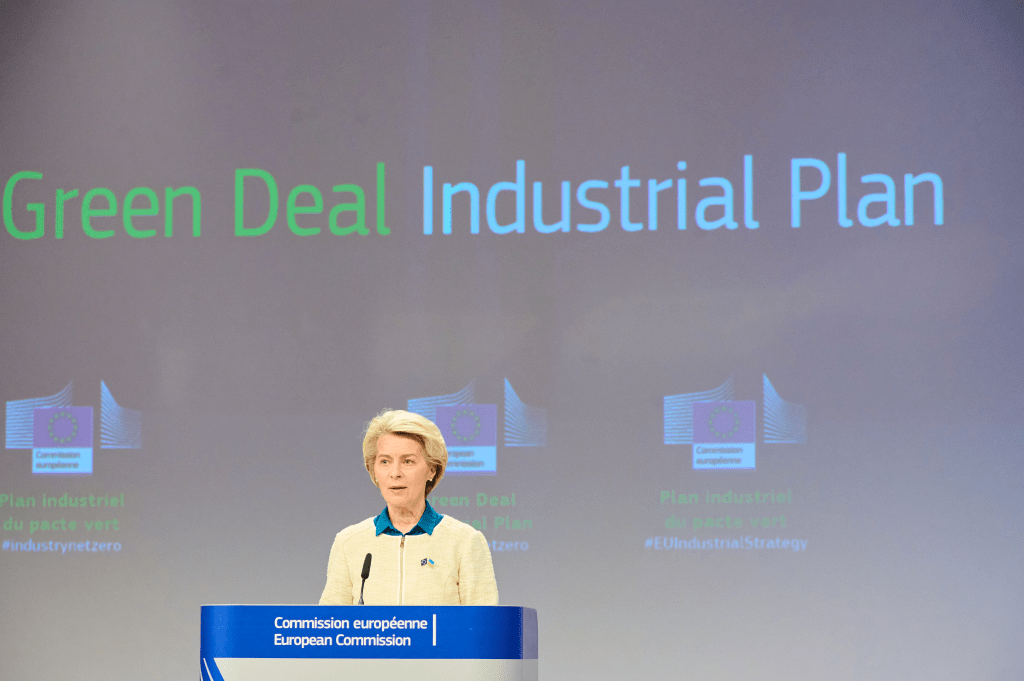
The EU suffered a massive loss with Russia’s war on Ukraine, with a majority of their energy supply coming from the oil giant. In a rush to ratchet up energy investments and protect national security interests, the EU announced the “Green Deal Industrial Plan” on February 1st of this year. The Green Deal Industrial Plan’s main objective is to boost the EU’s energy investments to become a global climate tech tyrant. A staggering 250 billion Euros have been allocated into this to support its initiatives through various funding packages, including relying on private funding, which differs from the IRA. Tax breaks are also provided for businesses that have net zero investments.
Global funding for energy transitions have surpassed 1 trillion dollars, with China assumed to be in the lead.
Eu/Dati Bendo
First, it’s important to note that the EU has a collective target to be net-zero by 2050. The Green Deal Industrial Plan builds off the European Green Deal, which set ambitions for the EU through initiatives such as the “Fit for 55” package, “REPowerEU Plan,” and the “Alongside the Circular Economy Action Plan.”
The Green Deal Industrial Plan has similarities to the IRA, promoting incentives for businesses and public procurement for enabling the purchase of net-zero technologies. The Plan also proposes the Critical Raw Materials Act, strengthening their extraction, processing, recycling, and international engagement to secure important raw materials needed for the shift into a green economy. One of the most important initiatives is the flexibility and quicker access to financials for the state to grant aid for renewable energy deployments, decarbonizing industrial processes, creating support schemes for production of net-zero technologies, and targeting aid for major new production projects in net-zero value chains.
The Plan goes on and on about skills and trade resilience for the EU, but let’s circle back to the climate. The acknowledgement of skill transfer is wholly important for the transition into a green economy, supporting training aid needed to facilitate the massive shift the EU is facing. This is a huge step for the EU to continue building off strong policy mechanisms for the green sector, adding a securitization aspect to protect industries and promote them in their transitions away from traditional, harmful energy sources. It does pose the question about decentralizations of green technology and whether it will rather become a national security interest, like we are witnessing now. Albeit, this is an important step and it will be interesting to see where big funding packages with incentives for local manufacturing and energy will take other states in their ambitions to lower their emissions.
This again circles back to the question: Is Vladimir Putin our greatest climate catalyst?
Let me know what you think!
 One Climate Blog