Is Vladimir Putin our greatest climate catalyst?
Listen to an audio recording of the blog below 🙂
https://www.instagram.com/_oneclimate/
The title of this blog is inspired by a colleague and may seem like a bit of a jump scare.. But, hear me out.
The Inflation Reduction Act (IRA) was enacted into US law on August 16, 2022. The purpose of the Act is to allow for drug price negotiation, enforcement of tax codes, and most importantly (ha) – investment in domestic energy products to lower US emissions 40% below 2005 levels by 2030, amounting to a one billion metric tonne decrease of carbon emissions. How it works is essentially closing tax loopholes, creating a minimum corporate tax, and so forth to generate revenue within the Act (1). These revenues are then used to cut the budget deficit and simultaneously re-invest in specific sectors of the US economy.
Inflation Reduction Act and Climate Change
The Inflation Reduction Act is a monumental climate movement signed into law by the Biden administration, allocating 369 billion of the total 433 billion dollars of investment to “Energy Security and Climate Change.” (1). Under this umbrella term includes a multitude of investments in carbon capture, electric vehicle capacities, solar and wind energy power growth, renewable manufacturing, and much, much more. Solar and wind energy projects that are off-shore also are eligible for tax credit provisions under the IRA (2).
The IRA encourages domestic energy manufacturing, supply, and storage. It aims to localize energy dependency, stimulating the economy within US borders to close the gap and encourage economic prosperity.
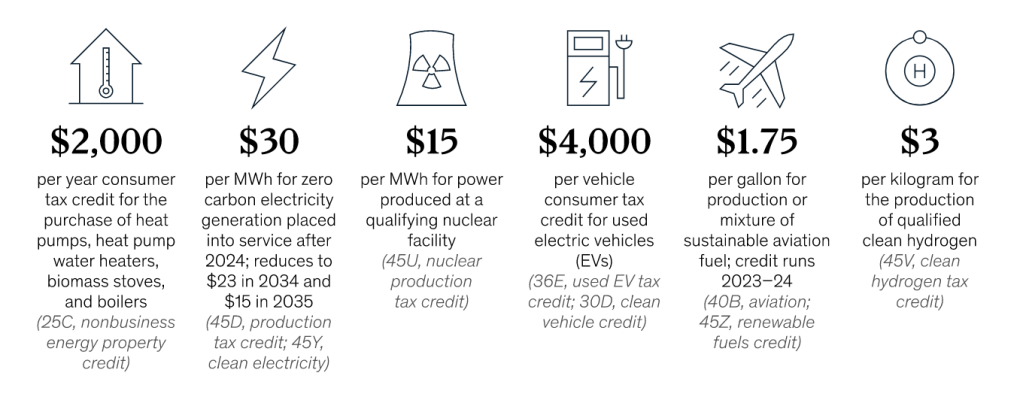
Incentives listed in the IRA (McKinsey & Company, 2022).
What does Putin have to do with this?
Despite the IRA being the new pillar of North American climate movement, it’s important to assess why it’s happening. After decades and decades of debates and scientists urging policy makers to create sustainable policies, what urged Biden to implement an ambitious set of metrics in law, now?
If we go back to how the senate framed the funding, it’s called “Energy Security… and Climate Change.” In light of ongoing events with geopolitical tensions rising from the Russia-Ukraine war, the US has been looking to bring investments “back home” to ensure economic dependency doesn’t waiver in the hands of other states internal conflict. With a highly globalized environment, it’s no surprise the ripple effects of the war have been substantial on the energy sector, with the US making the biggest cuts in Russia’s fossil fuel revenues alongside Poland (4). The reliance on Russian energy exports has shaken the global energy sector and has pushed economies to explore other means to protect their assets within their borders. And alas, the IRA was born.
The European Union
The enactment of the IRA has pushed the European Union (EU) to reassess their energy investments, fearing that investors will move their manufacturing to the US due to tax breaks, offshoring EU energy even further. This caused panic within the EU, with 60% of their fossil fuels coming from Russia, and now facing pressure of losing another piece of security in the green energy sector (4). In response, the EU announced their own form of an IRA, called the “Green Deal Industrial Plan” on February 1st 2023. Which will I will dive into in another blog post.
Overall, the Inflation Reduction Act is full of clean energy promises and sets a global precedence and pressure to get climate friendly investments moving. However, there are also a lot of downfalls to it. There is no mention of slowing down fossil fuel investments within the US, and also does not necessarily favour marginalized communities, often those that face the most climate impacts, to make changes in their communities.
I anticipate this to be a multiple part series regarding what this means for Canada, simultaneous fossil fuel investments, and how these funds are aimed to meet future energy demands and not supplement current needs.
Articles that helped me write this post!
- https://www.democrats.senate.gov/imo/media/doc/inflation_reduction_act_one_page_summary.pdf
- https://rwdi.com/en_ca/insights/thought-leadership/inflation-reduction-act-renewable-energy-industry/
- https://www.mckinsey.com/industries/public-and-social-sector/our-insights/the-inflation-reduction-act-heres-whats-in-it
- https://energyandcleanair.org/publication/russian-fossil-exports-first-100-days/
- https://www.reuters.com/markets/why-us-inflation-reduction-act-has-rattled-europe-2023-02-01/
 One Climate Blog