Ontario’s Greenbelt: Bill 23
In a new and unsurprising decision made by the Ford government, expansion plans for faster development were quietly approved this past December 2022. However, the plan for expansion takes place on Ontario’s Greenbelt, a “protected” strip of land comprised of wetlands, farmlands, rivers, lakes and forests (1). How protected is it really?
What is the Greenbelt?
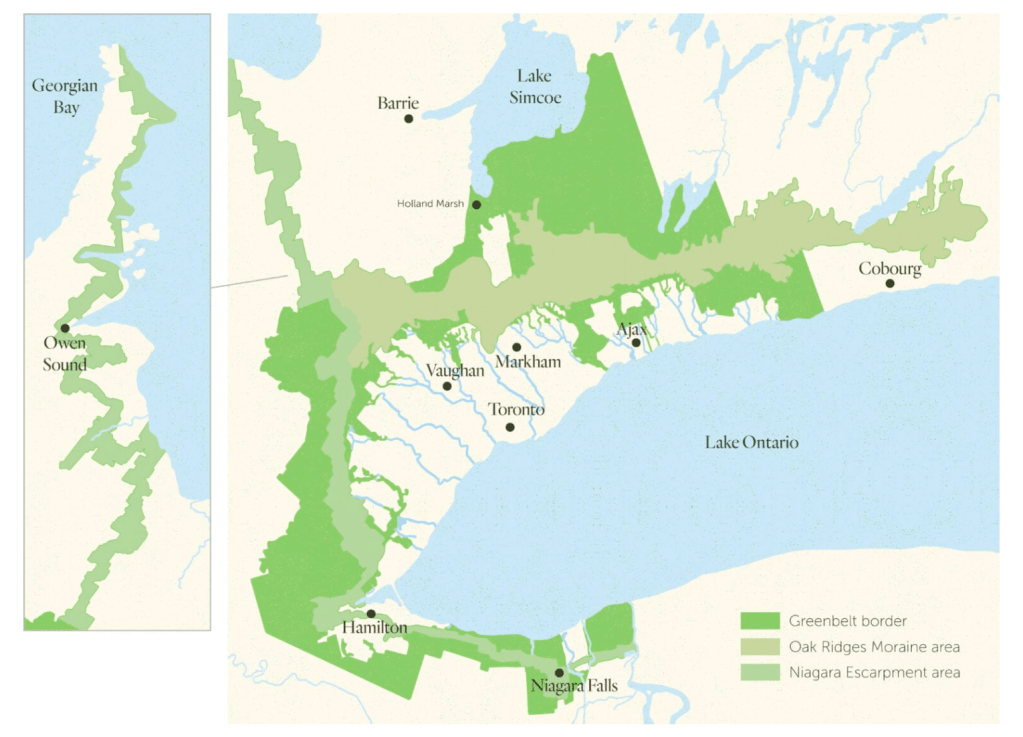
Map: Jeannie Phan
The Greenbelt runs through Niagara up to Northeastern Cobourg. Over 2 million hectares of protected space runs through this area, safeguarding resources that supply clean air and water conditions, while lowering flood risk and providing a vibrant selection of wildlife a home (1). It improves climate resiliency for Ontario, while ensuring local farming is protected with nearly 40% of the belt being allocated to a diverse range of agriculture. The Ford government has added 360 hectares to the Greenbelt in 2021, however Bill 23, “More Homes Built Faster,” plans to remove 7,400 acres to make space for 50,000 homes.
Bill 23: “More Homes Built Faster”
Throughout his time as Premier, Doug Ford has tried and failed to create development plans for the Greenbelt, however proposed a lengthy plan to address Ontario’s housing supply crisis by passing Bill 23. Bill 23 allows for development on over 7000 acres of protected land, while also enacting the “Supporting Growth and Housing in York and Durham Regions Act, 2022” (2). The bill goes on to repeal and change regulations that have been previously set in place, affecting the “Conservation Authorities act,” public consultation prior to disposition, minister reviews, appeals, and more (2). I could go into this forever and stray far from the environmental impacts, but I encourage you to read on this bill and the changes in consultation and power of the minister, along with its implications on sectors like development and the protection of the environment.
Why was this bill passed? Well, Premier Doug Ford highlights the housing supply crisis that Ontario is suffering, and amplifies the population growth of two million people by 2031 (3). With proposed development on the Green Belt, developers are expected to plan a “quick turn around” on the construction of a development. Without the conditions met of fast development, the property that was proposed for use will be “returned” back to the Greenbelt. This raises questions of who “owns” the Green Belt to be “returned?” How can we ensure that quality, low emission housing is made if conditions rely on fast paced development? Is the Ford government going to tighten housing bylaws and regulations to ensure sustainable development is being created on the Greenbelt? Simply having conditions for 1:1 offset achievement does not tackle future issues Bill 23 proposes. The bill includes a proposal to add 9400 acres to the Greenbelt along with 13 urban river valleys, for an overall expansion of 2000 acres, however has not reached finality.
It’s also important to mention the rising cost of living and unaffordable rent prices that Ontario is facing, along with nearly 100,000 vacant homes that sit in the province. New developments created along the Greenbelt have nothing to do with creating accessible and affordable living for Ontario’s residents, but rather giving developers more room to create “cookie-cutter,” high emission and high cost homes to add to the vacancy list (5).
Opposition to Bill 23
To an environmentalist and really anyone that cares about the implications of climate change, it’s easy to see why Bill 23 is bad. It reduces climate resiliency in Ontario by allowing developers to build on lands that increase flood risks, while also endangering over 70 species that live on the Greenbelt and call it home. Most importantly, it sends an obscure message to climate deniers and capitalists that environmental policy can be compromised and debated.
As Bill 23 was passed, Doug Varty, the chair of Ontario Species Conservation Action Agency, resigned from his position. Varty expressed his frustrations with the current government and the dismay he felt at the dismantling of environmental protections (4). Over 85 rallies have been held in opposition, with thousands coming together to protest in front of MPP’s offices or making calls to stop the progression of Bill 23. Despite the cry for environmental protections and climate friendly legislation, Ontario has taken a massive step backwards, with residents now looking at the federal government to intervene.
What do you think the future of the Greenbelt looks like? Can we repeal Bill 23?
Articles that helped me write this post!
1 https://www.greenbelt.ca/learn
2 https://www.ola.org/en/legislative-business/bills/parliament-43/session-1/bill-23
4 https://thenarwhal.ca/ontario-species-at-risk-resignation/
5 https://storeys.com/greenbelt-has-nothing-to-do-with-affordable-housing/
 One Climate Blog